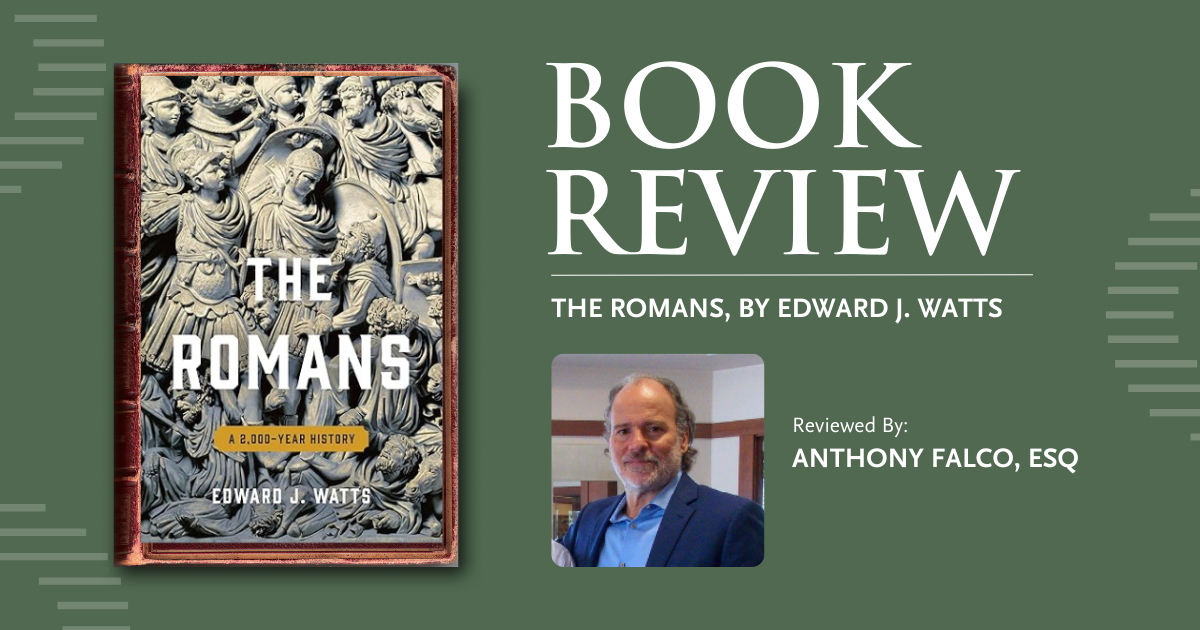
Book Review: The Romans by Edward Watts
Reviewed by Anthony Falco, Esq.
My son Christian gave me this 625-page book, The Romans, by Edward Watts, as a Christmas gift. Ironically, the growth of Christianity and its impact on the rise and fall of the Roman Empire is a central theme. More ironically, when I first saw the title, I romanticized reading about historical figures like Julius Caesar, Marc Antony, Cleopatra, Augustus, Marcus Aurelius, and Nero—along with 200 other emperors and influential figures. I imagined learning about the greatest, longest-standing, and most advanced society of the ancient world. My naivety is both shocking and, frankly, embarrassing. I had no idea how brutal life was and how cruelly power was obtained and maintained.
Do I Recommend This Book?
It depends. I wanted to quit 3–4 times, especially in the first 25 pages, which are filled with gore and humanity at its worst—think Game of Thrones multiplied by ten. Yet, I kept going, usually reading 5–10 pages a day, never more than a head-pounding 20. Here’s my recommendation: If you want to challenge yourself and are interested in history, politics, religion, and culture, read it. If you want to sleep well at night, do not.
What You’ll Learn
Roman and Historical Figures (800 BC – 1200 AD):
Julius Caesar, Augustus, Brutus, Caligula, Constantine, Marc Antony, Cleopatra, Marcus Aurelius, Pius, Hannibal, Justinian, Pompey, Charlemagne, St. John the Baptist, Saint John Chrysostom, Cicero, Cato the Younger, Spartacus, Nero, Cassius Dio, Trajan, Pope Innocent, Muhammad… and many others. Interestingly, there is very little about Jesus himself.
Political Transformations:
From the Roman Kingdom to the Republic to the Empire—and the split between West and East (Byzantium/Constantinople).
Religion and Culture:
The roles and interactions of the world’s religions, cultural exchanges, religious wars, persecutions, and internal splits.
Women of Rome:
Women were often oppressed and overlooked, yet many became shadow leaders, regents, or even empresses. Cleopatra, Plotina (wife of Trajan), Julia Domna, Julia Mamea, Ariadne, Theodora, Sophia, Irene, and Zoe are just a few examples of women who wielded significant power and influence, sometimes stepping in as de facto rulers or appearing on Roman coins.
Gore and Atrocities:
If you “like” gore, be prepared for: assassinations, blinding, castration, beheadings, slavery, plagues, suicides, bribery, torture, parricide, filicide, stabbings, slaughters, epidemics (smallpox, Ebola), natural disasters, and more.
Lessons and Parallels to Today
The book offers numerous parallels—and contrasts—with modern society:
● Separation of church and state
● Military influence on policy
● Political marriages
● Paid militaries and public works
● Imperialism and wars
● Banking, monetary systems, and taxes
● Wealth inequality and hyperinflation
● Propaganda
● Capital punishment
● Power consolidation and election bribery
● Civil wars and leadership failures
● Legal systems and universities (Justinianic Code)
● Influence of religious leaders and international diplomacy
How This Relates to My Work
I like to connect the books I read to my work at Senior Resource Center, Inc. and my law firm, Falco and Associates P.C. While it took some reflection, here’s what I found:
Mental sharpness: Reading complex, challenging works keeps the mind active—like my father-in-law’s nightly crossword puzzles.
Community: Sharing knowledge strengthens bonds. Community engagement is crucial for seniors to stay healthy, happy, and productive.
Succession planning: Just as emperors with clear succession plans ensured smoother transitions, a well-planned business succession reduces uncertainty among employees, partners, and clients.
If any of the above intrigues you, and you’re willing to tackle this massive book, reach out—I’d love to hear your thoughts: [email protected].

Anthony Falco, Attorney & Founder of Senior Resource Center, Inc.