If you’ve ever walked into a nursing home and felt your heart sink a little (the sterile lighting, the hospital smell, the distant sound of a TV no one is watching) you’re not alone. Most of us have been there. And most of us have quietly thought: there has to be a better way.
There is. And some countries are already doing it.
At Senior Resource Center Inc., we’ve spent years helping Massachusetts families navigate elder care options, and we believe that doing right by families means being honest, including about where the bar is set and who’s setting it higher. We’ve written before about what nations like Japan, the Netherlands, and Sweden are doing differently when it comes to caring for their aging populations. Today, we’re turning our attention to Switzerland, a country that quietly leads the world in reimagining what a nursing home can and should be.
More Than a Medical Facility
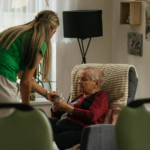
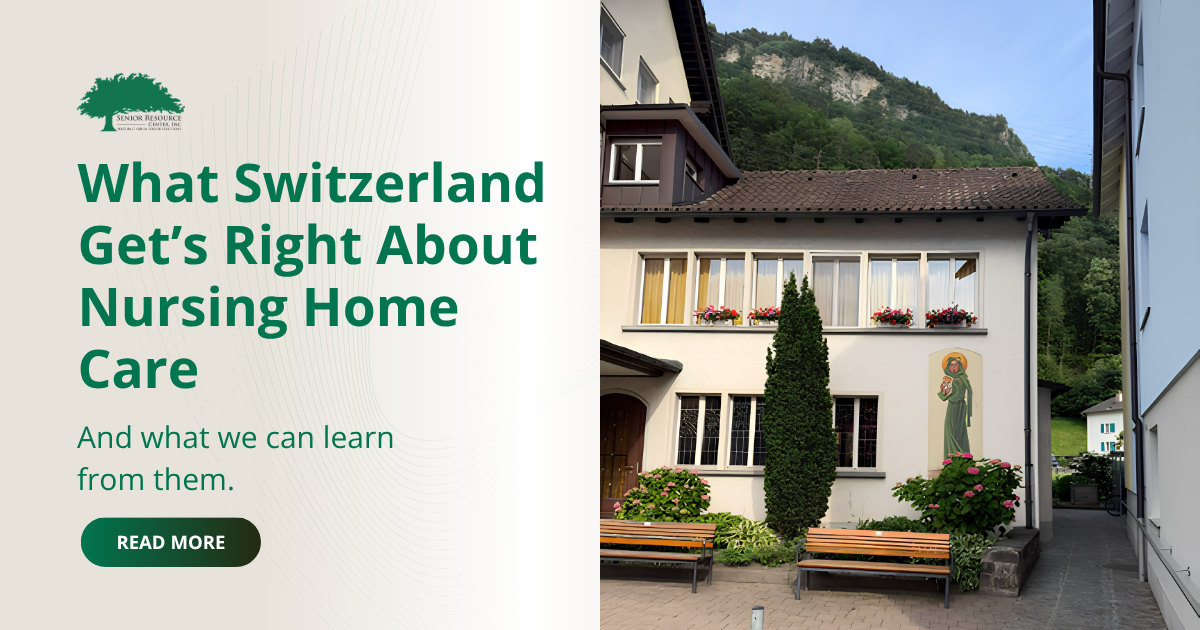
In Switzerland, a nursing home (known as an EMS, or Établissement Médico-Social) is designed from the ground up to be a home first and a medical facility second. The philosophy is built around three pillars: professional nursing care, yes, but also active social programming to maintain human connection, and genuine attention to quality of daily life, from meals to meaningful activity.
The Swiss model insists that reducing elder care to clinical tasks alone is a fundamental misunderstanding of what aging people need. And increasingly, research backs this up: dignity, autonomy, and meaningful social engagement are as vital to health outcomes as medication management.
Staffing as a Value, Not an Afterthought
Here’s where the contrast with the American model gets harder to look away from.
In the U.S., the average nursing home resident receives just 3.85 hours of nursing care per day, and that number has actually declined by 7% since 2015, driven largely by a 19% drop in registered nurse hours. Only 11% of for-profit facilities are currently meeting federal staffing standards, according to a 2024 Kaiser Family Foundation study. Meanwhile, 27% of U.S. nursing facilities have received deficiencies for actual harm or jeopardy to residents, up from 17% a decade ago. [ KFF + 2 ]
Switzerland, by contrast, has invested heavily in nursing workforce development, including a national initiative backed by over a billion dollars in government funding to train and expand the nursing workforce specifically for long-term care. Swiss nursing homes are actively implementing care models that incorporate nurses with advanced degrees and expanded clinical roles, creating more continuity and expertise for residents with complex needs. Wiley Online Library
The difference isn’t just in dollars. It’s in values.
The Rise of the Human-Scale Model
One of the most exciting developments in Swiss elder care is the growing movement toward smaller, more homelike living arrangements as an alternative to large institutional facilities.
Projects like La Maison du Soleil, developed by the Swiss non-profit Fondation Caliel, represent a new vision: small clusters of seniors living together in a true home environment, supported by staff who work alongside them rather than clocking in and out of a shift. The goal is to place dignity and autonomy back at the center, away from the constraints of the traditional institutional model, with a homelike, non-institutional living environment, maintained social connections, and personalized support that respects each individual’s pace. [ Fondation-caliel ]
Sound familiar? It should. The “culture change” movement in the U.S. has been pushing for exactly this for years. The difference is that in Switzerland, it’s becoming the norm rather than the exception.
What This Means for American Families
None of this is meant to shame anyone, not families who chose a nursing home out of necessity, not the dedicated aides and nurses who show up every single day in understaffed buildings and give everything they have, and not the facilities doing their best under real financial and regulatory constraints.
American nursing homes face a staffing crisis that is genuinely systemic. Average annual staff turnover in American nursing homes runs around 50%, a vicious cycle where understaffing makes the job harder, which drives more people out the door. The workers who stay are often burning out serving roles that pay no more than a shift at a big box store. [ PBS ]
The Swiss model succeeds in part because the entire society, government, insurers, families, and providers, treats elder care as a shared obligation rather than a private market transaction. That’s a structural difference that a single facility, or even a single state, can’t simply decide to replicate overnight.
But here’s what we can do: raise our expectations. Ask better questions. Demand more transparency. Look for facilities that prioritize staffing levels, genuine human connection, and resident autonomy rather than just compliance checkboxes. And as a country, start having an honest conversation about what we actually owe the people who built everything we’re standing on.
SRC’s Commitment to Better
The Swiss aren’t doing something magical, they made smart choices. They decided that a nation’s character is reflected in how it treats its most vulnerable. We believe the same is true of an organization.
Finding better care for our clients is an ongoing commitment. The families who come to us are trusting us with some of the hardest decisions of their lives. We stay current on what best-in-class care looks like, here in Massachusetts and around the world, because our clients deserve recommendations grounded in the highest standards available, not just the most convenient ones.
We will keep pushing, on behalf of every family we serve, for the kind of care that honors the people receiving it.